What a newborn actually sees
Newborn visual acuity is roughly 20/400 — the world is soft, close, and low-contrast. What cuts through is bold contrast at short range: in the looking-time experiments that founded infant vision research, newborns gazed longest at strong black-and-white patterns and simple face-like shapes (Fantz, 1961). That focused looking is how the young visual system exercises itself.
Color arrives on its own schedule. Around 2–3 months babies begin to discriminate colors, and red is typically first — which is why the classic progression of high-contrast play is black & white from birth, then add red around 3 months.
This is a print-and-play fact, not a screen fact: the research is about physical patterns during supervised awake time. Our free printable card sets follow exactly this progression — black & white from birth, black-white-red from about 3 months, held 8–12 inches away during tummy time.
The best developmental "program" is a conversation
The strongest, most repeated finding in early-childhood science is almost boring: young brains are built through back-and-forth interaction with caring adults — what Harvard's Center on the Developing Child calls "serve and return." Your baby coos, points, or babbles (the serve); you respond with eyes, words, or a smile (the return). Thousands of these loops a week are the developmental program.
Language shows it most clearly. It isn't just how many words children hear — the number of back-and-forth conversational turns predicts language ability and even language-related brain activity (Romeo et al., 2018). A striking experiment made the same point with video: 9-month-olds exposed to Mandarin learned its sounds from a live tutor but learned nothing from the identical lessons on video (Kuhl et al., 2003). Presence, gaze, and response are the active ingredients.
- Narrate the boring stuff — diapers, groceries, walks. It all counts.
- Pause after you speak; even pre-verbal babies "answer." That's a turn.
- Sing — infant-directed singing holds attention and soothes better than almost anything recorded.
- Daily supervised tummy time builds the motor base that later learning stands on.
What the research really says about screens
Under ~18–24 months: skip them (video chat is fine)
The AAP recommends no screen media before about 18–24 months, and the WHO recommends none before age 2. This isn't caution for its own sake — children under roughly 30 months consistently learn far less from video than from the same content live, a robust phenomenon researchers call the video deficit (Anderson & Pempek, 2005; Barr, 2010). Babies don't get what adults get from screens, so the honest move is not to sell them screen time at all. (Grandparent video calls are the exception — they're interactive, which is the whole point.)
Ages 2–5: quality and company matter more than minutes
From about age 2, high-quality video can genuinely teach — the Sesame Street and Blue's Clues research literatures established that decades ago. The AAP suggests about an hour a day of high-quality content, ideally watched together. What separates "high-quality" from noise is surprisingly specific:
Add repetition — young children learn from seeing the same thing again and again (Barr, 2010) — and movement breaks, in line with WHO guidance to limit sitting still. That's the complete, published recipe.
How TwinkleHush applies all of this
We build everything to the strongest version of the evidence — and we refuse the marketing that the evidence doesn't support. No product of ours will ever claim to "boost your baby's brain." Here is the honest map:
Sleep content (from birth) — audio, not video
Steady noise and slow lullabies are the evidence-backed part (see the sleep science), so our long-plays are audio-first: near-dark, still visuals, quiet mastering, safe-volume guidance in every description, and an explicit "dim the screen" instruction.
Sensory content (0–6 months) — paper first
Because the high-contrast research is about physical objects, the real product is the free printable cards, following the black-and-white-then-red progression. The matching videos — black & white from birth, then black, white & red from about 3 months — exist as inspiration and for supervised moments — never marketed as developmental.
Learning videos (ages 2+) — the published recipe, exactly
Each episode teaches one idea, at a deliberately slow pace, with real answer pauses after every question, heavy repetition, printed words synced to speech, a stand-up-and-move break, and a co-viewing prompt for the grown-up. Every episode also passes an automated no-flashing photosensitivity check before upload, and the design research is summarized in each video's description — so you can check our work. See it in practice in Colors & Shapes Ep. 1: Learn the Color RED.
Sound for sleep. Paper for babies' awake time. Slow, together-watched video from age two. And your voice above all of it.
Watch — the awake-time content, honestly labelled
Sensory videos are a screen companion to the printable cards for supervised awake moments, a few minutes at a time — never marketed as developmental. Learning videos are for ages 2+, watched together. Links open on YouTube.
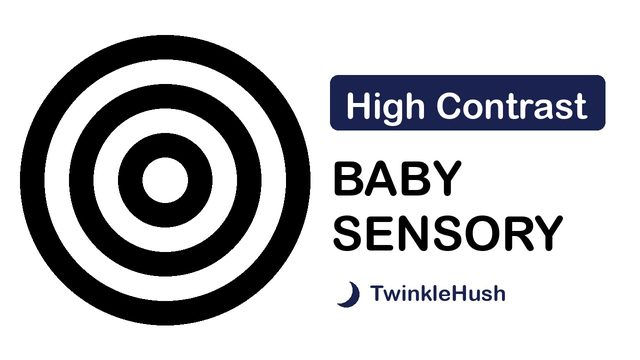
High Contrast Sensory awake time · 0+ mo
Slow black-and-white shapes and faces with gentle music — a screen companion to card Set 1.
Watch on YouTube →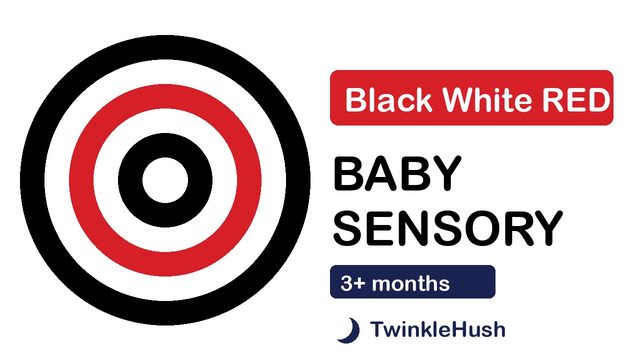
Black, White & Red Sensory awake time · 3+ mo
The classic next step once color vision arrives — red joins the patterns, matching card Set 2.
Watch on YouTube →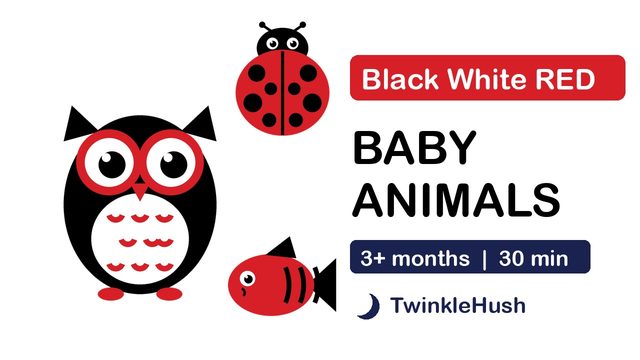
Black, White & Red Animals awake time · 3+ mo
Fifteen friendly animals — owl, fish, ladybug, whale — drifting slowly across a clean white screen, with a gentle animal song. Matches card Set 3.
Watch on YouTube →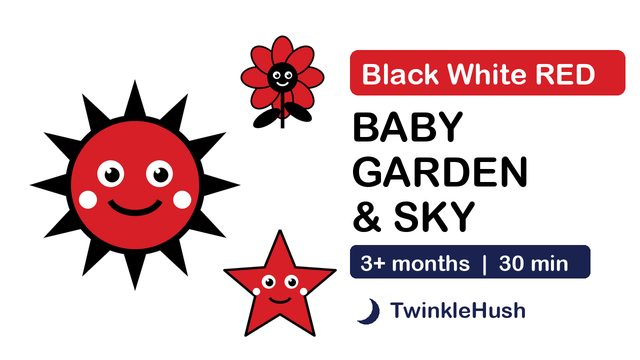
Black, White & Red Garden & Sky awake time · 3+ mo
Sun, flower, cloud, star and moon with slow secondary motion (turning rays and petals) over a music-box medley. Matches card Set 4.
Watch on YouTube →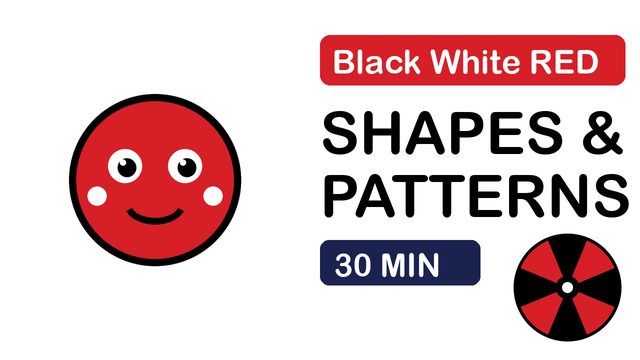
Black, White & Red Shapes & Patterns awake time · 3+ mo
Eight shapes with faces and seven slow-turning patterns — circle-dots, spiral, pinwheel — the high-contrast classics. Matches card Set 5.
Watch on YouTube →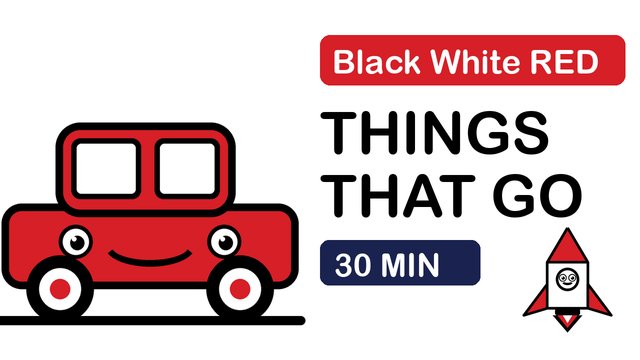
Black, White & Red Things That Go awake time · 3+ mo
Fifteen vehicles with friendly faces — car, train, rocket, fire truck, helicopter with a slow-turning rotor — over a warm music-box medley and a soft clip-clop beat.
Watch on YouTube →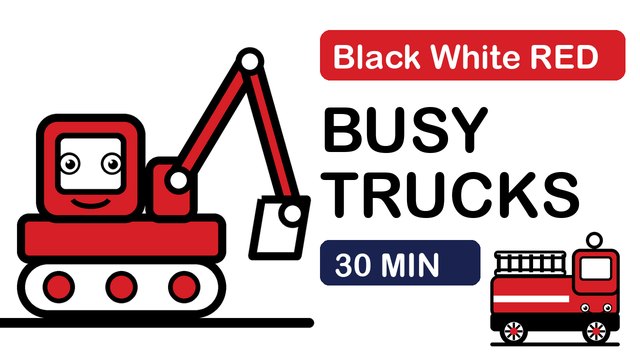
Black, White & Red Busy Trucks & Diggers awake time · 3+ mo
Fifteen busy vehicles with friendly faces drive slowly across the screen — digger, fire engine, cement mixer, crane, taxi — wheels turning, each one saying hello with a soft music-box note.
Watch on YouTube →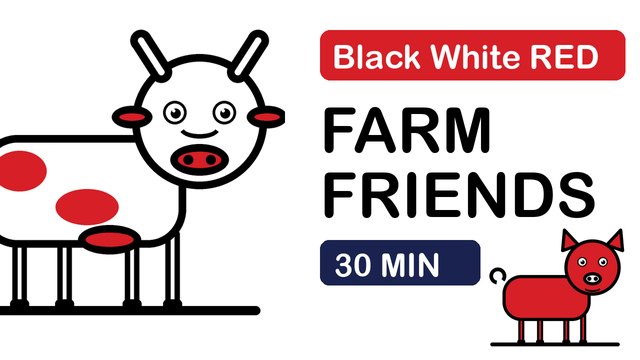
Black, White & Red Farm Friends awake time · 3+ mo
Fifteen farm friends walk slowly across the screen — cow, pig, sheep, hen, tractor — tails and ears moving, each one saying hello with its own soft music-box call.
Watch on YouTube →Learn the Color RED ages 2+ · Ep. 1
Colors & Shapes episode 1: one idea, slow pace, real answer pauses, a movement break, a co-viewing prompt.
Watch on YouTube →Looking for the sleep long-plays? Those are audio-first content — they live on the baby sleep page.
The same science, as Shorts
Parent-facing, a minute long, study cited on screen. More arrive as we make them.
Seven findings that sound made up, and what to do with each
Each of these is a peer-reviewed study, checked at the publisher, with one practical takeaway. None of them requires buying anything.
Babies taste what you eat, before they are born
Pregnant women were randomised to drink 300 mL of carrot juice or water, 4 days a week for 3 weeks, either in the last trimester or during the first 2 months of breastfeeding. At the infants' first carrot-flavoured cereal, the carrot-exposed babies showed fewer negative facial expressions than with plain cereal, and the prenatally exposed group was rated by mothers as enjoying it more; the water group showed no difference (Mennella, Jagnow & Beauchamp, Pediatrics, 2001). Takeaway: eat the foods you want your baby to accept later.
Skip the nap and the new memory does not stick
Six- and twelve-month-olds learned novel actions. Only infants who napped for at least 30 minutes within 4 hours of learning remembered the actions 4 hours and 24 hours later; age-matched infants who stayed awake did not, and at 24 hours the nappers were significantly ahead (Seehagen et al., PNAS, 2015). Takeaway: after a big learning moment, protect the next nap.
Eight-month-olds find words in gibberish in two minutes
Infants heard a continuous stream of made-up syllables with no pauses and no meaning for 2 minutes, then distinguished the hidden "words" from non-words using only the statistics of which syllable follows which (Saffran, Aslin & Newport, Science, 1996). Takeaway: talk in full, natural sentences. Their brains do the segmentation.
Night breast milk carries melatonin. Day milk does not
In 10 mothers 3 to 4 days after birth, milk melatonin was undetectable in the afternoon and about 99 pmol/L between 2 and 4 a.m. Six mothers who sampled every feed for 24 hours all showed the rhythm. The authors proposed it might communicate time-of-day information to the infant (Illnerová, Buresová & Presl, J Clin Endocrinol Metab, 1993). Takeaway: if you pump, label bottles day and night and give night milk at night.
French newborns cry in a rising melody. German newborns, falling
Recordings of 30 French and 30 German newborns showed that French infants preferentially produced rising cry contours and German infants falling ones, matching the intonation of each language heard in the womb (Mampe, Friederici, Christophe & Wermke, Current Biology, 2009). Takeaway: they have been listening since the last trimester. Keep talking.
Immediate skin-to-skin cut deaths in small babies by a quarter
Across five countries, 3,211 babies born at 1.0 to 1.8 kg were randomised to immediate kangaroo mother care (about 16.9 hours a day of skin-to-skin) or conventional incubator care first (1.5 hours). By day 28, 12.0% had died with immediate skin-to-skin versus 15.7% without, a relative risk of 0.75. The trial was stopped early for benefit (WHO Immediate KMC Study Group, N Engl J Med, 2021). Takeaway: ask for skin-to-skin in the first hour, and keep going.
Does sleep training harm attachment? One trial checked a year later
Forty-three infants aged 6 to 16 months were randomised to graduated extinction, bedtime fading, or sleep education. Both interventions cut time to fall asleep; infant cortisol fell slightly rather than rising. At the 12-month follow-up there were no significant differences in emotional or behavioural problems or in secure-versus-insecure attachment (Gradisar et al., Pediatrics, 2016). It is a small trial and it does not tell any family what to choose. Takeaway: the feared harm was looked for and not found.
Common questions, answered from the research above
Do flashcards or baby apps help babies learn to talk?
Not in the way a person does. In the classic experiment, 9-month-olds learned new speech sounds from a live tutor and nothing from the identical lessons on video (Kuhl et al., 2003). What predicts language growth is the back-and-forth: your baby babbles, you answer. Those conversational turns predict language ability beyond the raw number of words heard (Romeo et al., 2018). Narrating, naming, and answering the babble is the free version, and it is the one the evidence supports.
What can a newborn actually see?
Roughly 20/400 acuity: a soft, close, low-contrast world. Bold black-and- white patterns and simple face-like shapes at 8–12 inches are what cut through (Fantz, 1961). Colour discrimination begins around 2–3 months, with red typically first — which is why high-contrast play goes black & white from birth, then adds red.
Is screen time bad for babies under 2?
The AAP recommends no screen media before about 18–24 months and the WHO none before age 2, because children under roughly 30 months learn far less from video than from the same thing live — the "video deficit" (Anderson & Pempek, 2005; Barr, 2010). Video chat with a grandparent is the exception: it's interactive, which is the whole point. This is also why we never market any video, including ours, as developmental for infants.
How much screen time is OK for a 2–5 year old?
The AAP suggests about an hour a day of high-quality content, ideally watched together. Quality is specific: slow pacing (a fast cartoon measurably impaired 4-year-olds' self-control right afterward — Lillard & Peterson, 2011), one idea per episode, pauses that let the child answer out loud, repetition, and an adult talking along (Strouse et al., 2013).
What is "serve and return"?
Harvard's Center on the Developing Child's term for the loop that builds young brains: the child coos, points, or babbles (the serve) and a caring adult responds with eyes, words, or a smile (the return). Thousands of these loops a week are the developmental program — no product required.
Can a baby taste what the mother eats during pregnancy?
Yes. Flavours reach the amniotic fluid and breast milk. Babies whose mothers drank carrot juice in late pregnancy or early breastfeeding showed fewer negative expressions and more enjoyment at their first carrot cereal than babies of mothers who drank water (Mennella et al., Pediatrics 2001).
Do naps help babies remember what they learn?
In 6- and 12-month-olds, only infants who napped at least 30 minutes within 4 hours of learning new actions remembered them 4 and 24 hours later (Seehagen et al., PNAS 2015).
Is there melatonin in breast milk?
Yes, at night. In a study of 10 mothers, milk melatonin was undetectable in the afternoon and about 99 pmol/L between 2 and 4 a.m., with a clear 24-hour rhythm (Illnerová et al., J Clin Endocrinol Metab 1993). If you pump, label bottles by day and night.
Does skin-to-skin contact after birth save lives?
In a trial of 3,211 babies born at 1.0 to 1.8 kg, immediate skin-to-skin care reduced deaths by day 28 from 15.7% to 12.0%, a 25% relative reduction; the trial was stopped early for benefit (WHO Immediate KMC Study Group, NEJM 2021).
Does sleep training damage attachment?
In a randomised trial of 43 infants aged 6 to 16 months, graduated extinction and bedtime fading improved sleep, cortisol fell slightly, and at 12 months there were no differences in attachment or emotional and behavioural problems versus controls (Gradisar et al., Pediatrics 2016). It is a small trial and does not tell a family what to choose.
Selected references
- Fantz RL (1961). The origin of form perception. Scientific American, 204(5), 66–72.
- Center on the Developing Child, Harvard University. Serve and Return (developingchild.harvard.edu).
- Romeo RR, et al. (2018). Beyond the 30-million-word gap: children's conversational exposure is associated with language-related brain function. Psychological Science, 29(5), 700–710.
- Kuhl PK, Tsao FM, Liu HM (2003). Foreign-language experience in infancy: effects of short-term exposure and social interaction on phonetic learning. PNAS, 100(15), 9096–9101.
- Anderson DR, Pempek TA (2005). Television and very young children. American Behavioral Scientist, 48(5), 505–522.
- Barr R (2010). Transfer of learning between 2D and 3D sources during infancy. Developmental Review, 30(2), 128–154.
- Lillard AS, Peterson J (2011). The immediate impact of different types of television on young children's executive function. Pediatrics, 128(4), 644–649.
- Strouse GA, O'Doherty K, Troseth GL (2013). Effective coviewing: preschoolers' learning from video after a dialogic questioning intervention. Developmental Psychology, 49(12), 2368–2382.
- American Academy of Pediatrics (2016). Media and Young Minds. Pediatrics, 138(5). · World Health Organization (2019). Guidelines on physical activity, sedentary behaviour and sleep for children under 5 years of age.
- Mennella JA, Jagnow CP, Beauchamp GK (2001). Prenatal and postnatal flavor learning by human infants. Pediatrics, 107(6), e88.
- Seehagen S, Konrad C, Herbert JS, Schneider S (2015). Timely sleep facilitates declarative memory consolidation in infants. PNAS, 112(5), 1625–1629.
- Saffran JR, Aslin RN, Newport EL (1996). Statistical learning by 8-month-old infants. Science, 274(5294), 1926–1928.
- Illnerová H, Buresová M, Presl J (1993). Melatonin rhythm in human milk. J Clin Endocrinol Metab, 77(3), 838–841.
- Mampe B, Friederici AD, Christophe A, Wermke K (2009). Newborns' cry melody is shaped by their native language. Current Biology, 19(23), 1994–1997.
- WHO Immediate KMC Study Group (2021). Immediate "Kangaroo Mother Care" and survival of infants with low birth weight. N Engl J Med, 384(21), 2028–2038.
- Gradisar M, et al. (2016). Behavioral interventions for infant sleep problems: a randomized controlled trial. Pediatrics, 137(6), e20151486.